
Filing an income tax return in India as an NRI is mandatory in many situations — and beneficial even when it is not. This guide tells you exactly when you must file, which ITR form to use, what documents you need, and how FinCirc India handles your filing completely online from anywhere in the world.
When Is ITR Filing Mandatory for NRIs?
As an NRI, you are required to file an Income Tax Return in India if your total taxable income from Indian sources exceeds the basic exemption limit in a financial year. For FY 2025-26 (AY 2026-27):
- Old Tax Regime: ₹2,50,000 (below 60 years of age)
- New Tax Regime (default): ₹4,00,000
When Should You File Even If Not Mandatory?
You should file an ITR even if your income is below the threshold when:
• TDS has been deducted on your NRO account, rental income, or property sale — filing is the only way to claim a refund
• You want to carry forward capital losses to offset future gains
• You need to apply for a Visa that requires ITR proof
• You are planning to obtain a home loan in India
• Your income includes foreign assets that require Schedule FA disclosure
Which ITR Form Should NRIs File?
Choosing the wrong ITR form is one of the most common mistakes NRIs make when filing independently. Here is the correct form based on your income type:
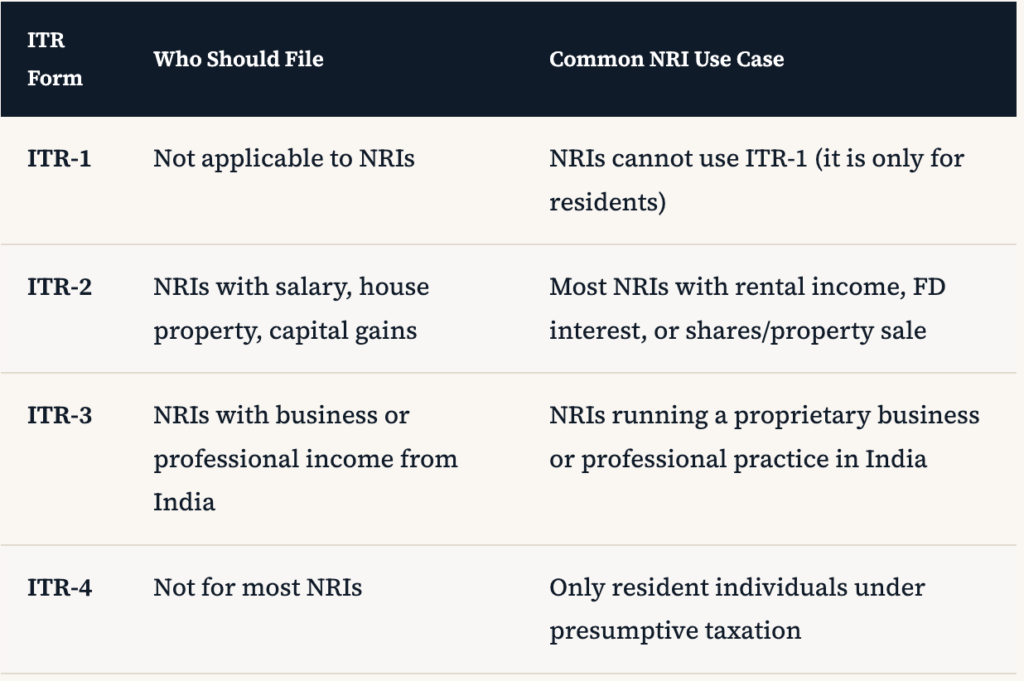
The most common form for NRIs is ITR-2. It covers salary income, rental income from Indian property, capital gains from shares or property, and foreign income disclosure. NRIs with Indian assets exceeding ₹1 crore must also declare them in the relevant schedule.
Step-by-Step: How NRI ITR Filing Works at FinCirc India
Document Collection (Day 1–2)
We send you a structured checklist. You share documents securely via our client portal — Form 26AS, AIS, bank statements, TDS certificates, sale deeds if applicable.
Income Computation & Regime Selection (Day 2–3)
Our CA calculates your total taxable income and compares Old vs New Regime to determine which saves more tax. DTAA benefits are applied where applicable.
Review & Approval (Day 3–4)
You receive a detailed computation sheet. We walk you through every line — income, deductions, tax payable, and TDS refund due. No surprises.
Filing on the Income Tax Portal (Day 4–5)
We file your ITR on the Income Tax e-filing portal. You receive the ITR-V acknowledgement immediately.
Verification & Refund Tracking (Day 5–30)
We e-verify your return using Aadhaar OTP, Net Banking, or DSC. Refunds are typically processed within 30–45 days of verification. We track and update you.
Documents Required for NRI ITR Filing
- PAN Card (mandatory — apply for one if you do not have it)
- Aadhaar Card (if linked; not mandatory for NRIs but recommended)
- Form 26AS and AIS — downloadable from income tax portal (shows all TDS deducted)
- NRO/NRE account statements for the financial year
- TDS certificates (Form 16A) from banks or tenants
- Rental agreements for Indian properties
- Sale deed / purchase deed for any property sold during the year
- Capital gains statements from brokers / mutual fund houses
- Tax Residency Certificate (TRC) from your country of residence (for DTAA benefits)
- Passport copy with travel history (to confirm NRI status)
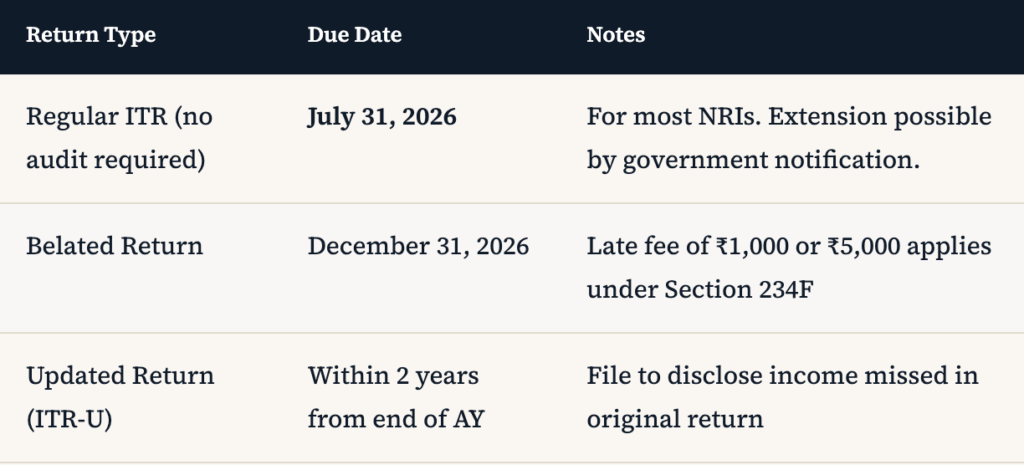
ITR Filing Deadlines for NRIs — FY 2025-26
Common Mistakes NRIs Make While Filing ITR
- Filing ITR-1 instead of ITR-2 — ITR-1 is invalid for NRIs. The return gets rejected.
- Not claiming DTAA benefits — NRIs from countries with DTAA treaties often overpay TDS when they do not submit a TRC.
- Missing Schedule FA — If you have foreign bank accounts, foreign assets, or income from foreign sources, Schedule FA must be filled. Omitting it is a compliance violation.
- Using wrong residential status — Filing as a Resident when you are an NRI (or vice versa) triggers notices from the Income Tax Department.
- Not carrying forward capital losses — Losses from share or property sales can offset future gains — but only if declared in the ITR for the relevant year.
- Not verifying the return — An unverified ITR is treated as invalid, even if filed on time.
NRI ITR Filing: Penalties for Non-Compliance
What Happens If You Don’t File?
• Late filing fee: ₹1,000 if income ≤ ₹5 lakh; ₹5,000 if income > ₹5 lakh (Section 234F)
• Interest on tax due: 1% per month under Section 234A from due date
• Loss of TDS refund: You forfeit refunds for the year if you do not file within the belated return deadline
• Prosecution: Willful failure to file where taxes are due can attract prosecution under Section 276CC
• Difficulty repatriating funds: Banks often require ITR proof for large fund repatriations from NRO accounts